Available for New Projects
EIRA — Designing a Retreat Planning Platform That Removes the Chaos Without Removing the Joy 🏝️
EIRA — Designing a Retreat Planning Platform That Removes the Chaos Without Removing the Joy 🏝️
EIRA — Designing a Retreat Planning Platform That Removes the Chaos Without Removing the Joy 🏝️
HR leads were planning company retreats with a spreadsheet, four WhatsApp groups, and the kind of nervous energy that comes from spending other people's money on something that has to go well.
HR leads were planning company retreats with a spreadsheet, four WhatsApp groups, and the kind of nervous energy that comes from spending other people's money on something that has to go well.
HR leads were planning company retreats with a spreadsheet, four WhatsApp groups, and the kind of nervous energy that comes from spending other people's money on something that has to go well.

Role & Team
Role:
Founding Product Designer
Scope:
User research, UX, UI, design system
Team:
Small founding team. Only designer.
Timeline:
6 months (MVP)
Context block
EIRA is an end-to-end B2B retreat planning platform — destination discovery, itinerary building, vendor coordination, and attendee management in one place. The problem it was solving was real. The platform I had to design it into didn't exist yet.
EIRA is an end-to-end B2B retreat planning platform — destination discovery, itinerary building, vendor coordination, and attendee management in one place. The problem it was solving was real. The platform I had to design it into didn't exist yet.
EIRA is an end-to-end B2B retreat planning platform — destination discovery, itinerary building, vendor coordination, and attendee management in one place. The problem it was solving was real. The platform I had to design it into didn't exist yet.
Over six months, I designed the MVP from the first interview to the first retreat. During the pilot, 10+ retreats ran through the platform, including international trips with 80+ attendees.
Over six months, I designed the MVP from the first interview to the first retreat. During the pilot, 10+ retreats ran through the platform, including international trips with 80+ attendees.
Over six months, I designed the MVP from the first interview to the first retreat. During the pilot, 10+ retreats ran through the platform, including international trips with 80+ attendees.
Problem
Company retreat planning is fragmented by design. Travel agents handle venues. HR handles headcount and dietary restrictions. Finance handles budgets. The activity coordinator is usually just whoever volunteered. They communicate across email, WhatsApp, Google Forms, and a shared spreadsheet that three people have accidentally edited simultaneously.
Company retreat planning is fragmented by design. Travel agents handle venues. HR handles headcount and dietary restrictions. Finance handles budgets. The activity coordinator is usually just whoever volunteered. They communicate across email, WhatsApp, Google Forms, and a shared spreadsheet that three people have accidentally edited simultaneously.
Company retreat planning is fragmented by design. Travel agents handle venues. HR handles headcount and dietary restrictions. Finance handles budgets. The activity coordinator is usually just whoever volunteered. They communicate across email, WhatsApp, Google Forms, and a shared spreadsheet that three people have accidentally edited simultaneously.
None of the existing tools talked to each other. The person responsible for the retreat was also responsible for making all those tools talk to each other. That person was usually an HR lead who was also doing their actual job at the same time.
None of the existing tools talked to each other. The person responsible for the retreat was also responsible for making all those tools talk to each other. That person was usually an HR lead who was also doing their actual job at the same time.
None of the existing tools talked to each other. The person responsible for the retreat was also responsible for making all those tools talk to each other. That person was usually an HR lead who was also doing their actual job at the same time.
Approach
I ran 10+ interviews with HR leads, people ops managers, and executive assistants who had recently planned team retreats before I touched Figma. Not to validate assumptions — I didn't have many yet — but to understand the texture of the problem.
I ran 10+ interviews with HR leads, people ops managers, and executive assistants who had recently planned team retreats before I touched Figma. Not to validate assumptions — I didn't have many yet — but to understand the texture of the problem.
I ran 10+ interviews with HR leads, people ops managers, and executive assistants who had recently planned team retreats before I touched Figma. Not to validate assumptions — I didn't have many yet — but to understand the texture of the problem.
What I found reshaped almost everything:
What I found reshaped almost everything:
What I found reshaped almost everything:
The itinerary was the hardest part — not the logistics. People could figure out flights and hotels. What they couldn't figure out was how to design two days of experience for 60 people with different energy levels, different dietary needs, and different definitions of a good team activity.
The itinerary was the hardest part — not the logistics. People could figure out flights and hotels. What they couldn't figure out was how to design two days of experience for 60 people with different energy levels, different dietary needs, and different definitions of a good team activity.
The itinerary was the hardest part — not the logistics. People could figure out flights and hotels. What they couldn't figure out was how to design two days of experience for 60 people with different energy levels, different dietary needs, and different definitions of a good team activity.
Trust was the primary barrier to new vendors. An HR lead who'd been burned by a venue that looked great in photos was not going to use a new vendor without a strong signal that they were reliable.
Trust was the primary barrier to new vendors. An HR lead who'd been burned by a venue that looked great in photos was not going to use a new vendor without a strong signal that they were reliable.
Trust was the primary barrier to new vendors. An HR lead who'd been burned by a venue that looked great in photos was not going to use a new vendor without a strong signal that they were reliable.
They wanted smart defaults, not blank canvases. Nobody wanted to start from scratch. They wanted something to react to and customize — not a form to fill in.
They wanted smart defaults, not blank canvases. Nobody wanted to start from scratch. They wanted something to react to and customize — not a form to fill in.
They wanted smart defaults, not blank canvases. Nobody wanted to start from scratch. They wanted something to react to and customize — not a form to fill in.
I changed the product's opening experience based on that last insight. Instead of "create your retreat," the first screen became "what kind of retreat do you want?" — a small but real shift from creator mode to curator mode.
I changed the product's opening experience based on that last insight. Instead of "create your retreat," the first screen became "what kind of retreat do you want?" — a small but real shift from creator mode to curator mode.
I changed the product's opening experience based on that last insight. Instead of "create your retreat," the first screen became "what kind of retreat do you want?" — a small but real shift from creator mode to curator mode.
Challenges and trade-offs
The hardest decision was the itinerary builder: it had to feel flexible to the planner and structured to the attendee.
The hardest decision was the itinerary builder: it had to feel flexible to the planner and structured to the attendee.
The hardest decision was the itinerary builder: it had to feel flexible to the planner and structured to the attendee.
A planner wants to drag blocks around, try different sequences, and add custom sessions. An attendee wants to know where to be and when, with no ambiguity. Those are different products sharing the same data.
A planner wants to drag blocks around, try different sequences, and add custom sessions. An attendee wants to know where to be and when, with no ambiguity. Those are different products sharing the same data.
A planner wants to drag blocks around, try different sequences, and add custom sessions. An attendee wants to know where to be and when, with no ambiguity. Those are different products sharing the same data.
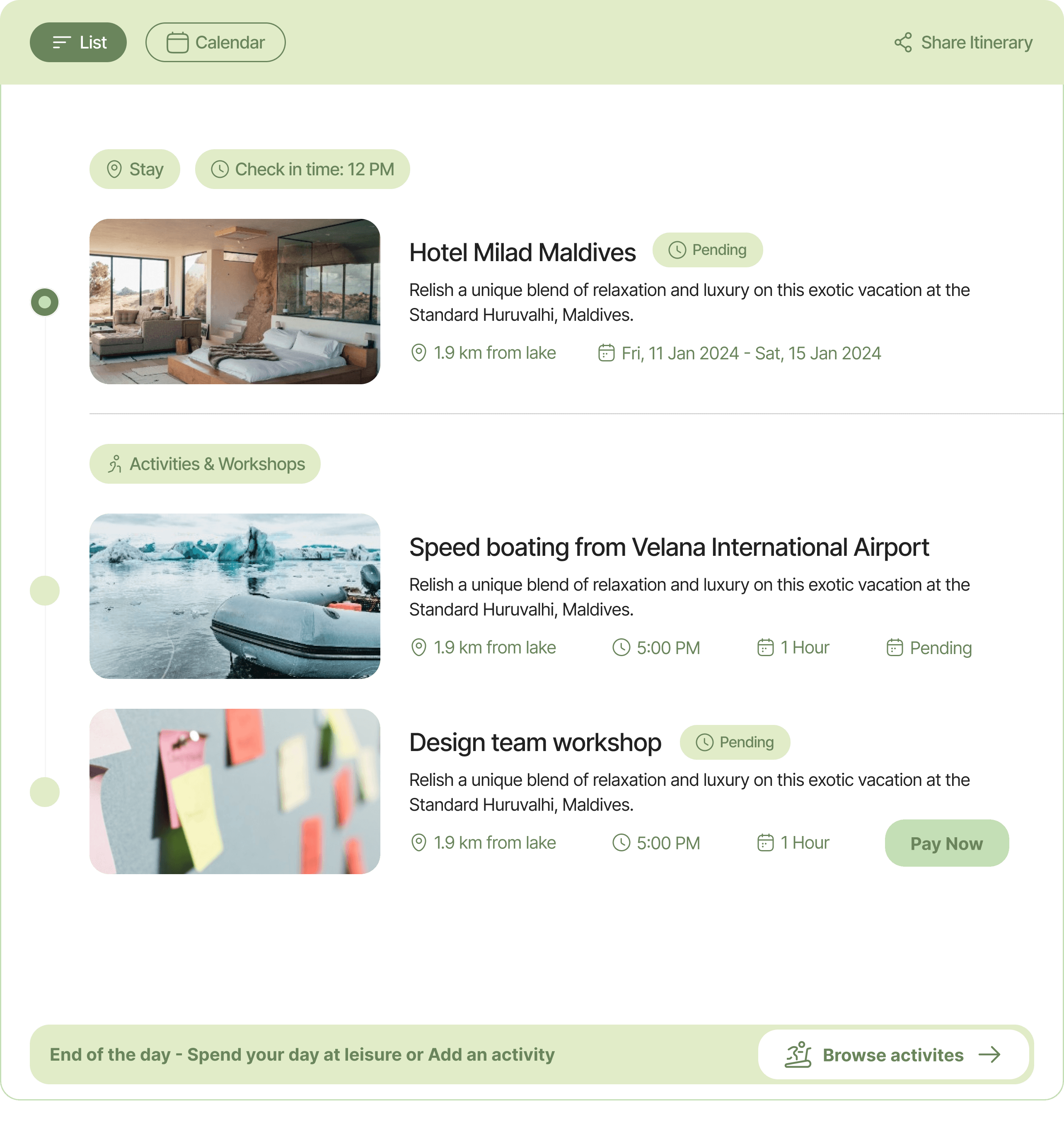
I solved it with a role-specific view toggle. The planner sees the builder — editable, draggable, annotatable. The attendee sees a published read-only schedule with their name and preferences embedded into it. The same itinerary, two completely different interfaces.
I solved it with a role-specific view toggle. The planner sees the builder — editable, draggable, annotatable. The attendee sees a published read-only schedule with their name and preferences embedded into it. The same itinerary, two completely different interfaces.
I solved it with a role-specific view toggle. The planner sees the builder — editable, draggable, annotatable. The attendee sees a published read-only schedule with their name and preferences embedded into it. The same itinerary, two completely different interfaces.
The preview was key: the planner could see exactly how the attendee would experience the schedule before publishing. That single feature eliminated most of the "I didn't realise it would look like that" moments in user testing.
The preview was key: the planner could see exactly how the attendee would experience the schedule before publishing. That single feature eliminated most of the "I didn't realise it would look like that" moments in user testing.
The preview was key: the planner could see exactly how the attendee would experience the schedule before publishing. That single feature eliminated most of the "I didn't realise it would look like that" moments in user testing.

Solution
The retreat creation flow started with curation, not configuration. Team size, dates, and retreat type unlocked destination cards — each with climate, travel time, average cost range, and top activities. The first decision a planner makes became easier, not harder.
The retreat creation flow started with curation, not configuration. Team size, dates, and retreat type unlocked destination cards — each with climate, travel time, average cost range, and top activities. The first decision a planner makes became easier, not harder.
The retreat creation flow started with curation, not configuration. Team size, dates, and retreat type unlocked destination cards — each with climate, travel time, average cost range, and top activities. The first decision a planner makes became easier, not harder.
The itinerary builder let planners schedule day by day, set role-specific tracks (all-hands vs. leadership-only), and see a real-time attendee preview. Time conflicts auto-highlighted. Sessions could be marked optional. The builder felt like planning; the output felt like a real schedule.
The itinerary builder let planners schedule day by day, set role-specific tracks (all-hands vs. leadership-only), and see a real-time attendee preview. Time conflicts auto-highlighted. Sessions could be marked optional. The builder felt like planning; the output felt like a real schedule.
The itinerary builder let planners schedule day by day, set role-specific tracks (all-hands vs. leadership-only), and see a real-time attendee preview. Time conflicts auto-highlighted. Sessions could be marked optional. The builder felt like planning; the output felt like a real schedule.
The vendor marketplace addressed the trust gap directly: verified badges, reviews from EIRA customers, photo-verified venue walkthroughs, and transparent pricing. Vendors could showcase their most popular retreat packages — giving planners something concrete to react to rather than a blank inquiry form.
The vendor marketplace addressed the trust gap directly: verified badges, reviews from EIRA customers, photo-verified venue walkthroughs, and transparent pricing. Vendors could showcase their most popular retreat packages — giving planners something concrete to react to rather than a blank inquiry form.
The vendor marketplace addressed the trust gap directly: verified badges, reviews from EIRA customers, photo-verified venue walkthroughs, and transparent pricing. Vendors could showcase their most popular retreat packages — giving planners something concrete to react to rather than a blank inquiry form.
The attendee portal collected dietary restrictions, room preferences, activity opt-ins, and travel arrival times in a single 3-minute flow. HR leads saw a live dashboard of response rates and preference summaries. No spreadsheet. No follow-up email chain.
The attendee portal collected dietary restrictions, room preferences, activity opt-ins, and travel arrival times in a single 3-minute flow. HR leads saw a live dashboard of response rates and preference summaries. No spreadsheet. No follow-up email chain.
The attendee portal collected dietary restrictions, room preferences, activity opt-ins, and travel arrival times in a single 3-minute flow. HR leads saw a live dashboard of response rates and preference summaries. No spreadsheet. No follow-up email chain.

Results & Impact
~45% reduction in planning time reported by HR leads compared to their previous process
~45% reduction in planning time reported by HR leads compared to their previous process
~45% reduction in planning time reported by HR leads compared to their previous process
92% post-retreat satisfaction score across the pilot cohort
92% post-retreat satisfaction score across the pilot cohort
92% post-retreat satisfaction score across the pilot cohort
10+ retreats organized during the pilot, including international trips with 80+ participants
10+ retreats organized during the pilot, including international trips with 80+ participants
10+ retreats organized during the pilot, including international trips with 80+ participants
50+ vendors onboarded to the marketplace
50+ vendors onboarded to the marketplace
50+ vendors onboarded to the marketplace
The most useful outcome I didn't anticipate: HR leads started using EIRA to plan retreats they hadn't planned to run. When the barrier to planning drops far enough, people start saying yes to things they'd previously decided weren't worth the effort.
The most useful outcome I didn't anticipate: HR leads started using EIRA to plan retreats they hadn't planned to run. When the barrier to planning drops far enough, people start saying yes to things they'd previously decided weren't worth the effort.
The most useful outcome I didn't anticipate: HR leads started using EIRA to plan retreats they hadn't planned to run. When the barrier to planning drops far enough, people start saying yes to things they'd previously decided weren't worth the effort.